
 Written by Miles Brampton •
•
6:00 AM (ET)
Written by Miles Brampton •
•
6:00 AM (ET)
Offshore online casinos operate outside the purview of United States licenses and regulation. Many though accept U.S. players with international gaming licenses.
This creates a legal gray area that often causes confusion for players trying to understand whether playing is illegal, risky, or unregulated. For players, this generally means there is no direct criminal enforcement, but little to no consumer protections.
U.S. gambling laws are there to regulate operators, payment processors, and financial institutions, not individual players.
This distinction is important. Playing at an offshore casino is not the same as playing at a state-regulated U.S. casino. There is no local regulator, and a dispute resolution process.
For an overview of gambling-related consumer protection and problem gambling support in the United States, visit the National Council on Problem Gambling. It’s an independent site that helps problem gamblers free of charge.
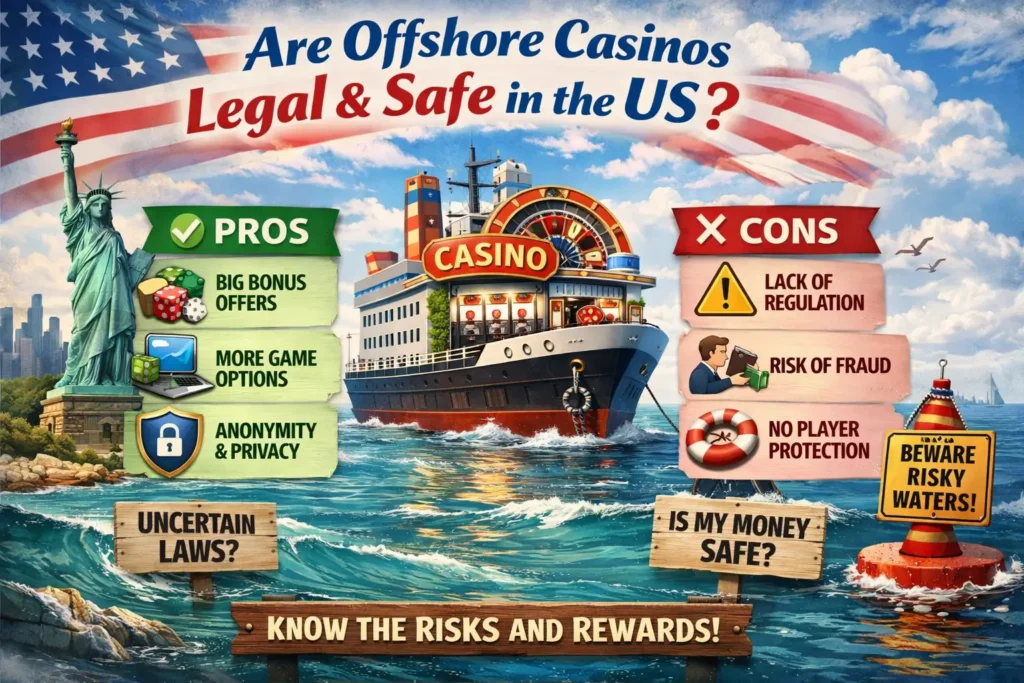
Player Risk vs Operator Risk
One of the biggest misconceptions about offshore casinos is that the legal risk is equal for players and operators. This is why offshore casinos focus heavily on internal rules, verification checks, and bonus enforcement.
Without a U.S. regulator overseeing them, offshore operators manage fraud, chargebacks, and abuse, sometimes at the expense of player convenience.
What does that mean for players? Withdrawal delays, unexpected verification requests, and bonus-related disputes. They are far more common than legal issues. Understanding how offshore casinos operate reduces these risks significantly.
Why Offshore Casinos Continue to Accept U.S. Players
Offshore casinos accept U.S. players because demand exists in states where regulated online casinos are unavailable or limited.
This does not mean offshore casinos are illegal by default. It means they operate outside U.S. regulatory frameworks. Some offshore casinos deliberately delay withdrawals, while others rely on aggressive marketing and vague terms.
Why Safety Matters More Than Legal Labels
Legality alone does not determine whether an offshore casino is safe. A casino can be legally operate offshore and still be a poor choice for players. Safety depends on payout reliability, transparency, customer support, and how it enforces its rules.
This guide focuses on identifying offshore casinos that demonstrate safer operating practices. Detailed explanations of how they handle deposits, verification, and withdrawals. In our next guide, we cover how offshore casinos work for U.S. players.
For more information about payment reliability and delays, check out our offshore casino withdrawals and payout timelines. Here we explain what is normal, what is not, and how to avoid common pitfalls when cashing out.
Understanding the legal structure is the first step. In the next section, we examine how to tell the difference between safer offshore casinos and those with higher-risk and where they have licenses.
Are Offshore Casinos Safe? What U.S. Players Should Look For
Safety at offshore casinos has less to do with a casino license, but more to do with how it treats its players. Many unsafe offshore casinos look legitimate on the surface, while safer sites operate honestly with fewer marketing claims.
Key Point:
Offshore casino safety is based on payout history, rule consistency, and transparency. Not on flashy licenses, big bonuses, or vague trust badges.
Common Offshore Licensing Myths
Offshore casinos often advertise licenses from jurisdictions such as Curaçao or other international gaming authorities. While licensing provides a basic framework, it does not guarantee player protection at the same level as U.S.-regulated gambling sites.
Many players mistakenly assume that a license means handling disputes. In reality, most offshore licenses seldom intervine when it comes to individual player complaints.
| Myth | Reality for U.S. Players |
|---|---|
| “Licensed = safe” | Licensing alone does not prevent payout disputes or delays |
| “No ID required” | Verification is necessary before they clear withdrawals |
| “Big bonus means generous casino” | Large bonuses often mean stricter wagering and withdrawal limits |
Real Safety Indicators That Matter Offshore
Safer offshore casinos share a few consistent traits. They may not look exciting at first glance, but they reduce risk for U.S. players over time.
- Clear withdrawal rules: Payment timelines, limits, and verification steps are clear.
- Consistent bonus enforcement: Apply the same rules to all players.
- Crypto-friendly payouts: Cryptocurrency reduces payment interference and chargeback risk.
- Stable operating history: Long-running casinos with consistent payout history are safer than new launches.
Safer Player Approach:
Offshore casinos that focus on payment reliability and operational consistency tend to outperform casinos that rely on constant promotions and aggressive marketing.
Red Flags That Signal Higher Risk
While no offshore casino is completely risk-free, certain behaviors indicate higher risk. These casinos often create frustration during the withdrawal process or shift rules mid-play.
- Repeated requests for new documents after the player already completed verification
- Bonus terms that change retroactively
- Vague withdrawal timelines with no written policy
- Customer support that avoids clear answers about payouts
What Happens If There Is a Dispute?
Unlike U.S.-regulated casinos, offshore casinos do not provide a guaranteed dispute resolution process through a state regulator. This means the casino handles disputes that may arise internally, or in limited cases, through the licensing authority.
This is why casino selection matters more than escalation options. Offshore casinos that value reputation tend to resolve issues. Casinos that rely on short-term player acquisition do not, unfortunately.